
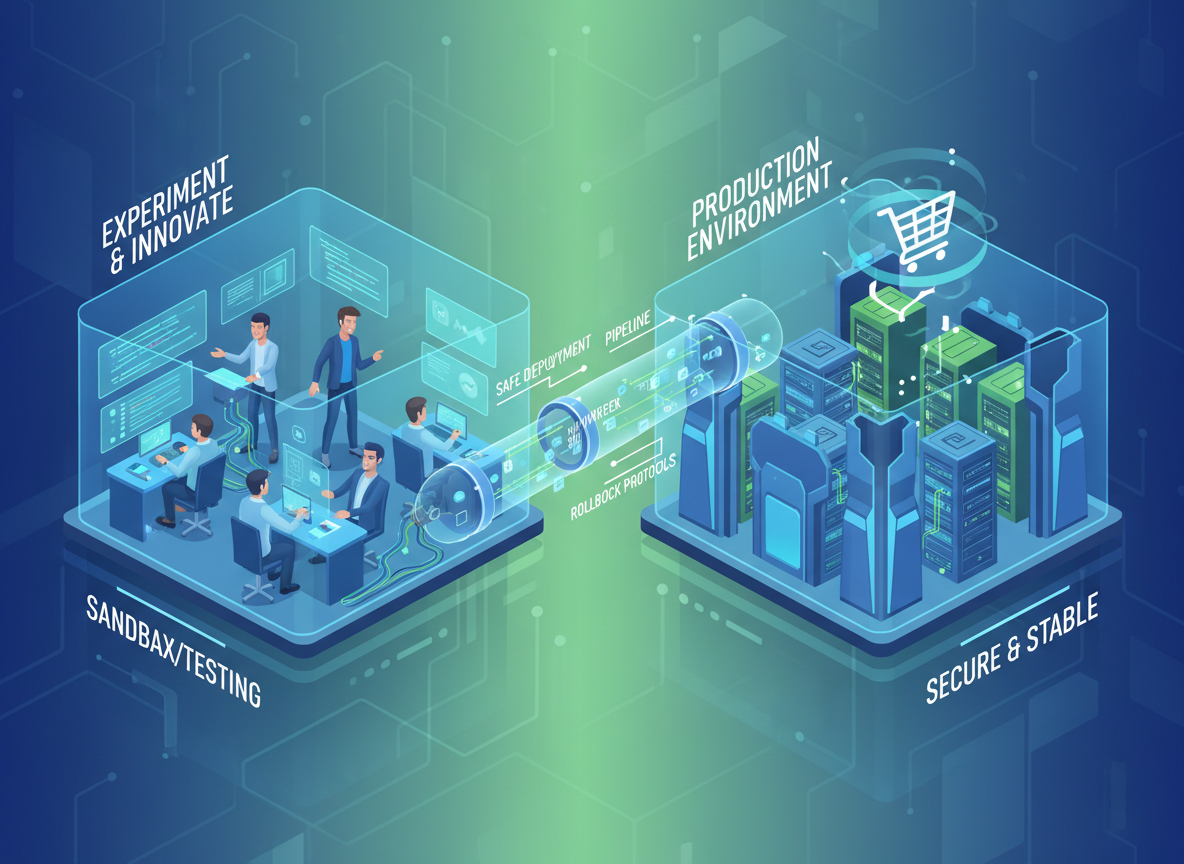
Why Safe Staging Environments Are the Secret to eCommerce Innovation
Innovation in eCommerce doesn't happen by accident. It happens when teams feel confident enough to experiment, test bold ideas, and push boundaries without fear of breaking their live store.
The difference between businesses that innovate and those that stagnate often comes down to one thing: the ability to try things in a safe place.
The Innovation Paradox
Here's the challenge every Magento merchant faces: your production site is your revenue engine. Every minute of downtime costs money. Every bug impacts customer trust. Every failed deployment creates chaos.
So what happens? Teams become risk-averse. New features get delayed. Testing becomes minimal. Innovation slows to a crawl.
The irony? The businesses that win in eCommerce are the ones that move fast, test constantly, and iterate quickly.
Safe Environments Unlock Experimentation
Staging environments solve this paradox. They give your team a production-identical space where failure has zero consequences.
When developers know they can spin up an environment, test a new payment gateway, break things, fix them, and try again—without touching the live site—everything changes.
Suddenly, questions shift from:
- "What if this breaks production?" to "Let's see what happens"
- "We can't risk testing that" to "Let's try three versions and see which works best"
- "Deployment is too risky" to "Let's ship this today"
At MDOQ, we've seen this transformation firsthand. With over 20,000 Magento development instances created and 14,000 zero-downtime deployments executed, we've watched teams go from cautious to confident.
What Makes a Staging Environment Truly Safe?
Not all staging environments are created equal. For a staging environment to genuinely encourage innovation, it needs to:
1. Mirror Production Exactly
Your staging environment should be an identical twin of production—same PHP version, same extensions, same configurations. Otherwise, you're not really testing safely; you're just hoping things work when you go live.
2. Use Real (Sanitized) Data
Testing with dummy data misses edge cases. You need production data—properly sanitized—to catch the bugs that only appear with real customer behavior, product catalogs, and order volumes.
3. Be Fast to Create
If spinning up a staging environment takes days of manual work, teams won't use it. Innovation requires speed. Automated instance creation means developers can test immediately, not eventually.
4. Support Multiple Concurrent Environments
One staging environment isn't enough. Different team members need to test different features simultaneously. Multiple isolated environments prevent bottlenecks and keep momentum high.
5. Integrate with Your Workflow
Staging environments should connect to your project management tools, version control, and deployment pipelines. When creating a test environment is as simple as clicking a Jira ticket, testing becomes routine rather than exceptional.
The Ripple Effects of Safe Testing
When teams have truly safe staging environments, the benefits multiply:
Developers become more productive. No more waiting for "the staging environment" to be free. No more manual setup. Just instant access to isolated test spaces.
Quality improves. Rigorous testing before production deployment catches bugs early, when they're cheap to fix rather than expensive to remediate.
Deployment frequency increases. With automated regression testing and zero-downtime deployment pipelines, teams can ship features weekly instead of quarterly.
Junior developers gain confidence. Safe environments are learning environments. New team members can experiment, make mistakes, and grow without production pressure.
Business agility increases. When technical teams can move fast safely, the entire business becomes more responsive to market opportunities.
From Caution to Confidence
The businesses thriving in eCommerce today aren't the ones avoiding risk—they're the ones that have created systems to manage it.
Staging environments aren't just about testing. They're about building a culture where trying new things is encouraged, where experimentation is expected, and where innovation becomes systematic rather than accidental.
When your team knows they can safely test anything, they stop asking "Can we?" and start asking "What if?"
That shift—from caution to confidence—is where real innovation begins.
Ready to give your team a safe space to innovate? MDOQ's automated development environments and deployment pipelines are built exclusively for Magento, with over 14,000 zero-downtime deployments and 20,000+ development instances created.
Learn More About MDOQ